Founded by Edinburgh entrepreneur Charlie MacGregor, The Social Hub (TSH) Glasgow is the 18th property to open in Europe for the pioneering Amsterdam-based company, with other locations currently operating in Austria, France, Germany, Italy, the Netherlands and Spain.
Breaking away from traditional hotel norms, The Social Hub, or TSH, has carved a niche for itself as a flexible environment where travellers, business professionals, students, and locals can learn, stay, work and play.
TSH is a thoroughly modern concept, blazing the trail for hybrid hospitality. What is this? In simple terms, TSH aims to bring together a diverse community – including travellers, students, business people, neighbours and more – to a space where they can learn, stay, work and play.
The Glasgow operation – on the brownfield Candleriggs Square plot – offers 494 rooms which double as student accommodation during term time and hotel rooms in holiday season, alongside flexible co-working and meeting spaces across 20,000 square-metres and has been designed to ‘inspire and connect creative minds through curated spaces, designed to capture the city’s gritty material’.
On top of that, the hotel’s shared social spaces boast an impressive rooftop pool, bar and restaurant – making the venue a must-use flexible option for a range of social, study or work events.
Members of TSH become part of a global community of ambitious creatives, digital nomads, entrepreneurs, and start-ups changing the world. They have the option to work in quiet and flexible spaces or brainstorm in private, expandable meeting rooms.
Membership also includes use of the gym and the ability to join in a range of networking events and workshops, ensuring an inspiring space where connections grow, ideas spark and change happens.
TSH Glasgow also features one of the city’s largest rooftop bars, as well as a ‘laid-back’ restaurant and bar serving a range of international and locally inspired food and drink options throughout the day.
Guests and residents are encouraged to revel in the energy and community of TSH, where everyone has the freedom to be themselves.
TSH believes a better society is created when people with vision and talent come together from all walks of life.
The company works tirelessly towards achieving this social impact objective and generating concrete value to the communities in which it operates by designing unique spaces that foster community building, coupled by an unparalleled programme of community experiences, and an ongoing commitment to monitoring the impact of its business operations.
Glasgow needs a city centre that is an attractive place to live, work, study, visit and invest – and the regeneration of Candleriggs Square can play an important role in delivering on all of those aims.
–
Councillor Susan Aitken, Glasgow City Council


Spotlight on the floor
Vebro Polymers and MJF Specialist Flooring have teamed up to showcase the flexibility of seamless flooring in flexible multi-occupancy spaces. The dichotomy of functionality and design align seamlessly within the smooth opaque flooring material, making it the ideal unassuming backdrop for hospitality to take centre stage.
- Resin applicator: MJF Specialist Flooring
- Material supplier: Vebro Polymers
- Total floor area: 800 m2
With an enviable brand whose trademark exudes contemporary design and versatility, it was inevitable that when it came to the interiors, The Social Hub would want to use design in a positive way that would spotlight the flexibility of each space and align to the overall concept.
Originally ceramic tiles were considered, but a resin comfort floor was ultimately chosen to ensure a seamless safeguard against scratches, stains, spillages and slips!
TSH specified Vebro Polymers’ polyurethane resin alternative to vinyl, vebroflex Comfort UV, to transform several accommodation, co-working and relaxation spaces in its latest Glasgow venue.
It is imperative that comfort floors be installed by experienced applicators in the field of resin flooring. Any cracks in the substrate should be bandaged or a levelling screed should be used to ensure a smooth, level surface prior to the installation of polyurethane comfort flooring. Comfort resin floors act like a skim, highlighting any imperfections in the substrate when cured if preparation isn’t taken seriously.
The area needs to be sealed prior to installation, with all windows and doors firmly closed, as well as free from any moisture or dust particles. Most resin comfort floors are two to three-layer systems and typically a day is recommended between each coat.
MJF Specialist Flooring expertly project managed and installed the flooring package at the TSH development, including all surface preparation work, the reinforcement of the existing screed, and the installation of the vebroflex Comfort UV system. The entire project was delivered in 25 days and involved just six MJF operatives.
Since 2006, MJF has built an enviable reputation in the installation of specialist flooring across the UK. Together, Vebro Polymers & MJF have delivered impressive transformations through the expert installation of high-performance epoxy, polyurethane, methyl-methacrylate and PU concrete flooring materials for an ever-growing number of both industrial and commercial end-user clients, including South Western Railway, Sunderland City Council, Stockton Globe, Kip & Nook and Jedburgh Grammar Campus.
As part of a new-build construction, the surface preparation deployed by the MJF team was straightforward once the newly poured concrete slab was deemed of sufficient strength and dryness to commence installation of seamless resin.
For new concrete to achieve its ultimate strength, excess water in the concrete mix must be allowed to evaporate. Proper preparation of concrete and the concrete surface is essential before any resin coating can be applied.
If the flooring system is installed too soon, bubbling, peeling, and a host of other problems can occur.
In addition, different areas of the slab may vary in moisture levels depending on how the concrete was mixed, as such testing for moisture in the slab was necessary to determine when works could start on site.
A moisture mitigating solvent-free epoxy primer was first installed and full-blind broadcast with graded aggregates prior to the installation of the vebroflex Comfort UV system to ensure good adhesion and a sound bond to the underlying substrate.
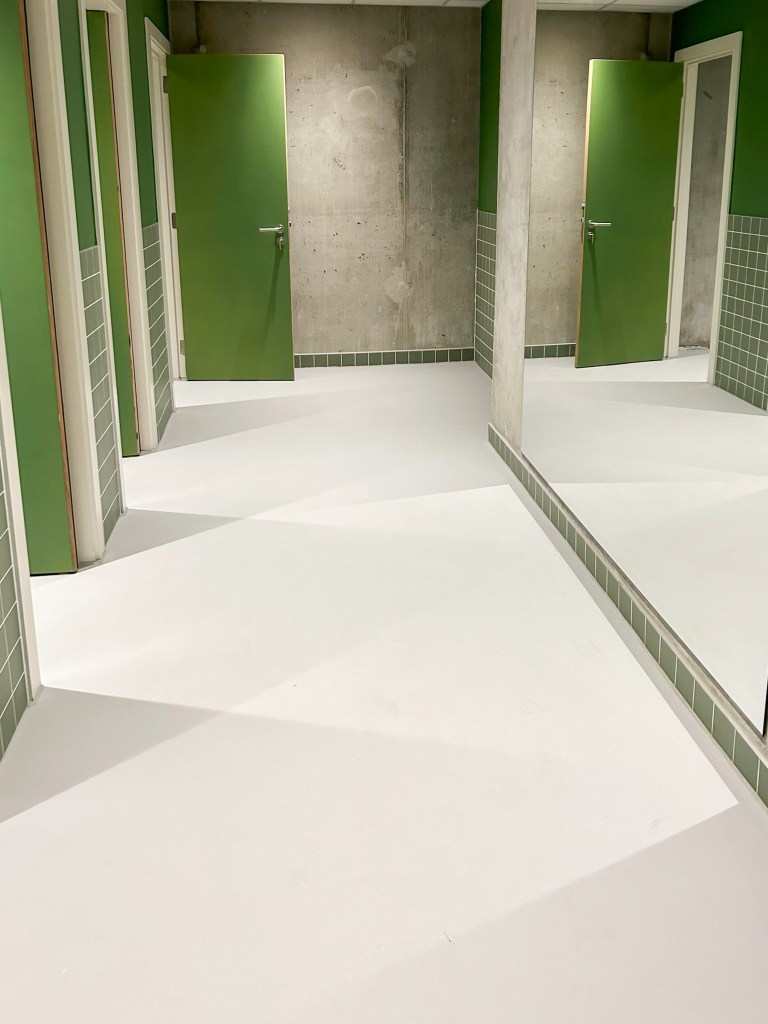
After suitable substrate preparation, a total of 800 m2 of vebroflex Comfort UV in the shade RAL 7035 Light Grey were chosen to transform the bar, restaurant, social activities space, co-working rooms and the lobby’s WC facilities at TSH’s new Candleriggs venue.
vebroflex Comfort UV is a solid-coloured, UV-stable, elasticised, polyurethane, multi-layer liquid-vinyl resin system that achieves up to 200% elongation at break. Once cured, the material delivers a smooth, matt-finish surface that deadens sound transfer between floors. Additional sound absorption can be achieved with a liquid membrane or rubber matting.
Other benefits include an elastic cushioned effect underfoot, as well as the capability to reduce heat loss between floors in multi-occupancy spaces.
Laid seamlessly at 3.0 mm, vebroflex Comfort UV is hygienic and very easy to clean away any spillages, all of which are contained on the surface of the floor with no risk of seeping into grouts lines or floor joints. It’s also non-porous, and therefore impervious to the absorption of liquids that can lead to stains.
Comfort resin flooring comes in a vast (virtually limitless) range of colours, decorative effects, and bold patterns – in this instance RAL 7035 was selected to provide a simplistic backdrop that could be dressed accordingly to what the space required of it that day! It also served as a mirror to the venue’s location reflecting the steely determination and industrial grit of its Glaswegian home.
The durability of resin flooring makes it more cost-effective when compared with other flooring systems such as tiles, sheet vinyl and linoleum; it’s more resilient, prone to wear and tear and therefore generally lasts a lot longer — a must in this public venue.
The sealer was also highly attractive to Gilbert-Ash overseeing the fit-out, as the aliphatic water-based clear matt sealer offers excellent scratch and wear resistance properties — perfect for preventing scratches from furniture and high heels!
The system’s excellent cleanability and seamless hygienic finish makes the vebroflex Comfort UV system an ideal choice for a busy multi-use accommodation and public venue like The Social Hub, where cleaning and maintenance should occur without disruption to visitors and guests.
It’s been great fun showing off TSH Glasgow, after such an amazing collaboration with the City of Glasgow and our local partners we can now see and feel what a great community we have here.
–
Charlie MacGregor, CEO – The Social Hub


Sustainability: A flooring choice fit for future generations
Incorporating environmental considerations into the build and interior fit-out of hospitality venues is crucial for creating sustainable, energy-efficient spaces that serve future generations.
After roughly 12 hours, a bodycoat layer of vebroflex PU SL a flexible, aromatic polyurethane self-leveller was applied using a notched steel trowel and spike rolled to release trapped air twice.
Within 24 hours, an even layer of the pigmented, aliphatic, water-based, matt-finish seal coat, vebroflex PU WB Seal (Matt) was applied using a short-pile or foam roller.
The system is AgBB certified low emissions in compliance with both BREAM and LEED regulations.
The AgBB evaluation scheme sets out the quality standards for building products intended for use indoors that are relevant to health. In doing so, the scheme fosters the innovation and development of low to zero emissions products.
The AgBB scheme has been developed in compliance with several international standards, including ISO 16000 standards and LEED, ensuring certified products meet the criteria set out, as well as contribute to building credits where applicable.
The low emissions status of polyurethane comfort resins offers significant advantages over the closest alternative, being sheet vinyl. The manufacture of vinyl flooring can cause toxic outgassing to occur after the floor is installed. This can release VOCs that can lead to negative health issues for the building’s users and occupants.
With correct care and maintenance, resin comfort floors can last well more than 10, 15, 20 years, even longer still with the routine refurbishment of the topcoat.
Resin comfort floors have a very cost-effective life-cycle profile in comparison to alternative floor coverings. At the end of their lifespan, resin comfort floors can simply be overlaid, whereas with sheet vinyl or linoleum this is typically non-biodegradable, rarely recyclable and often disposed of in landfill sites. Once damaged, vinyl requires ripping up and replacing, whereas polyurethane resins can be repaired.
Although a higher upfront square metre rate install cost, the reduced maintenance and energy costs over time combined with an enhanced lifespan makes resin comfort floors the economical choice over the footprint of its service life.
The opening of The Social Hub Glasgow marks the return of Candleriggs Square to what it once was as part of the city’s rich commercial history – a bustling marketplace full of life, vitality and interest, intrinsically linked to the rest of the city centre.
–
Graeme Bone, Group Managing Director – Drum Property Group


Let’s stay together: The rise of co-working & hybrid accommodation
Changing cultural trends have given rise to a new era of dynamic workspaces and multi-use social venues.
The idea of co-working is certainly attractive, businesses are able reduce their overheads on office buildings, throw a bit of networking in the mix, plus employees can have the option to either work from home or decide to visit a neutral shared space, or both! This could also certainly help with employee mental health by allowing them to avoid isolation when working from home and reduce distractions in the home office.
It was, and still is, quite acceptable to set up in a local coffee shop, but alternative spaces are changing the way we work. For example; we can ‘pay as you go’, discreetly collaborate, be part of a growing community, have a choice of where we work, and choose a ‘serviced’ building with amenities such as a gym, meeting rooms and shared communal areas.
More and more buildings are being either renovated and repurposed, or designed and built, for co-working, including those with accomodation and shared social spaces like The Social Hub.
Between 2006 and 2015, studies showed that the number of co-working spaces and available seats had roughly doubled each year so the working population is no stranger to the idea of co-working, and the requirement for such spaces is still on the rise. According to research, in 2018, there were just short of 17,000 co-working spaces, and 42,000 as of 2024.
What makes these spaces truly appealing to a new generation of workers goes beyond availability, location and convenience.
Typically, students, employees and entrepreneurs are looking for a space that aligns with their identity… working, study and accomodation venue that offers all of the required amenities alongside community, flexibility and a sense of belonging. The Social Hub’s goal is to create an environment where this is possible.
The company’s venues host a diverse community where people come to learn, stay, work and play, with its hybrid hospitality concept designed to welcome students, tourists, neighbours and business people to create meaningful and fun experiences under one roof.
What makes co-working and hybrid hospitality spaces truly appealing to a new generation of students, travellers and business people goes beyond availability, location and convenience.